Equipment
* optional
Ingredients
Baguette Dough
- 500 g bread flour, unbleached
- 350 ml water, lukewarm
- 10 g kosher salt
- 4 g instant yeast
Nutrition (per serving)
Method
In a large mixing bowl, combine the bread flour, lukewarm water, kosher salt, and instant yeast. Mix thoroughly until a shaggy dough forms and no dry spots of flour remain.
Perform a series of stretch and folds by pulling the edge of the dough up and stretching it over itself. Rotate the mixing bowl and repeat 4 to 5 times. Cover the bowl.
Allow the dough to ferment at room temperature until doubled in volume.
Turn the dough out onto a lightly floured surface. Divide it equally into 3 pieces. Gently fold the edges of each piece into the center to form a loose rectangle, then cover and let rest.
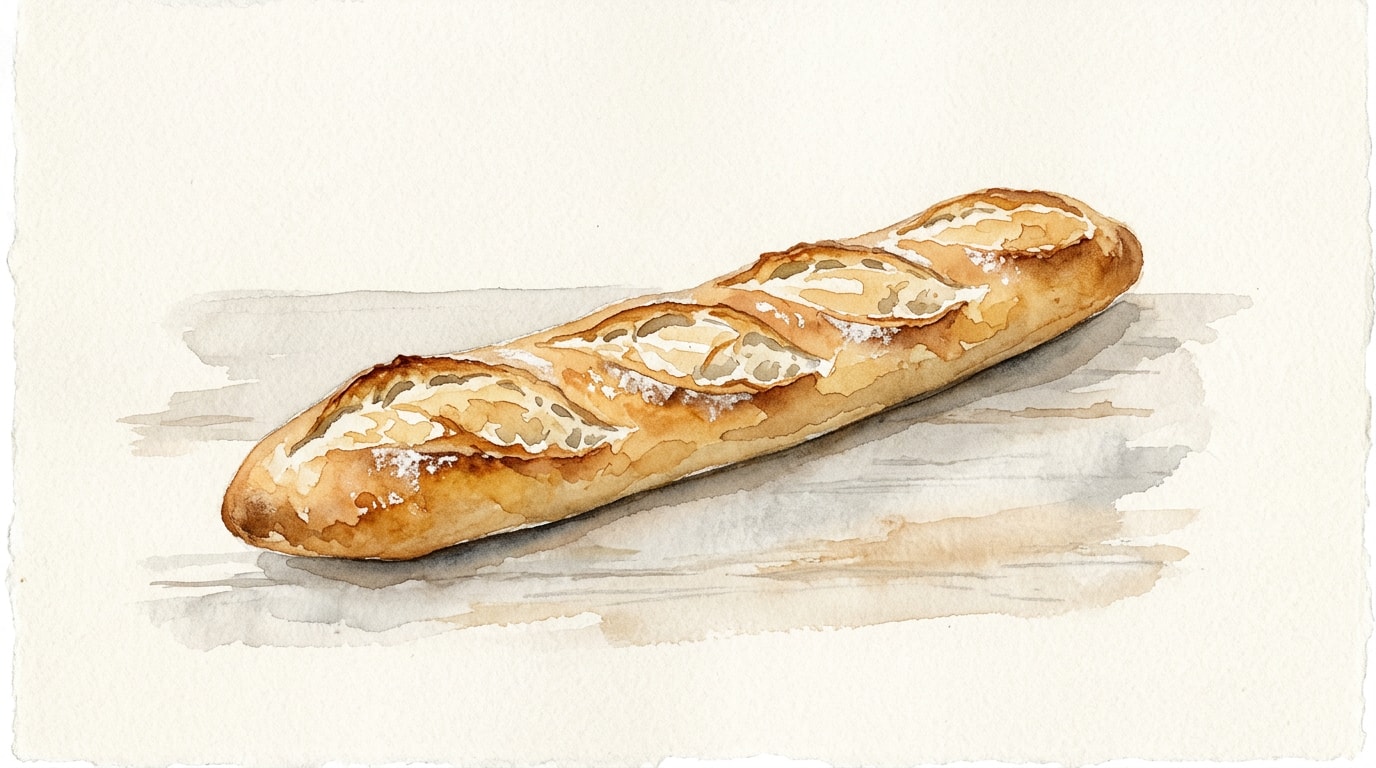
Shape each piece into a tight cylinder by folding the top edge down to the center, pressing the seam tightly, and rolling the dough out into a 35 cm log with tapered ends.
Place the shaped baguettes seam-side down on a generously floured couche or kitchen towel, creating pleats between each loaf to support their structure. Cover and proof until visibly puffy.
Preheat the oven to 250C or 480F. Place an empty oven-safe tray on the bottom rack of the oven to heat up.
Carefully transfer the baguettes to a baking sheet. Using a lame or sharp razor blade, make 3 to 4 quick, shallow cuts down the length of each loaf at a slight angle.
Place the baking sheet in the oven. Carefully pour 250ml of water into the hot bottom tray to create a burst of steam. Immediately close the oven door to trap the steam. Bake until the crust is a deep golden brown.
Transfer the baked baguettes to a wire rack. Allow them to cool completely before slicing so the internal moisture can redistribute properly.
Chef's Notes
- To achieve a truly crispy, artisan-style crust, steam is absolutely essential during the first half of baking.
- Handle the dough as gently as possible after the bulk fermentation phase to preserve the air bubbles that create an open, airy crumb.
- Using a razor blade or a specialized lame allows for the cleanest scores. Quick, confident slashes help control exactly how the bread expands in the oven.
- Ensure your water temperature is lukewarm. If the room is very warm, use cooler water; if the room is cold, use slightly warmer water to control fermentation speed.
Storage
Freezer: 3 months — Wrap tightly in foil and place in an airtight bag before freezing.
Reheating: Thaw at room temperature for 1 hour, then refresh in a 200C oven for 5 minutes.