Equipment
Ingredients
Dry Ingredients
- 400 g all-purpose flour
- 5 g fine sea salt
Wet Ingredients
- 4 eggs, room temperature
- 15 ml extra virgin olive oil
Dusting
- 30 g semolina flour
Nutrition (per serving)
Method
Combine the flour and salt on a clean work surface. Use your hands or a bowl to create a deep, wide well in the center of the flour mound.
Crack the eggs into the well and pour in the extra virgin olive oil. Using a fork, gently beat the wet ingredients together until smooth, being careful not to break the flour wall.
Gradually pull small amounts of flour from the inner walls of the well into the egg mixture. Keep whisking until a thick paste forms, then use a bench scraper or your hands to fold in the remaining flour until a shaggy dough comes together.
Knead the dough vigorously for 8 to 10 minutes. Push the dough away with the heel of your hand, fold it over itself, give it a quarter turn, and repeat. Continue until the dough is smooth, elastic, and springs back gently when pressed.
Wrap the dough tightly in plastic wrap and let it rest at room temperature around 20°C/68°F for at least 30 minutes. This hydrates the flour fully and relaxes the gluten network for easier rolling.
Cut the rested dough into four equal pieces, keeping the unused pieces wrapped. Flatten one piece slightly, then pass it through a pasta machine on its widest setting. Fold the sheet into thirds like a letter, press flat, and pass it through the widest setting twice more. Continue rolling through progressively thinner settings until you reach your desired thickness.
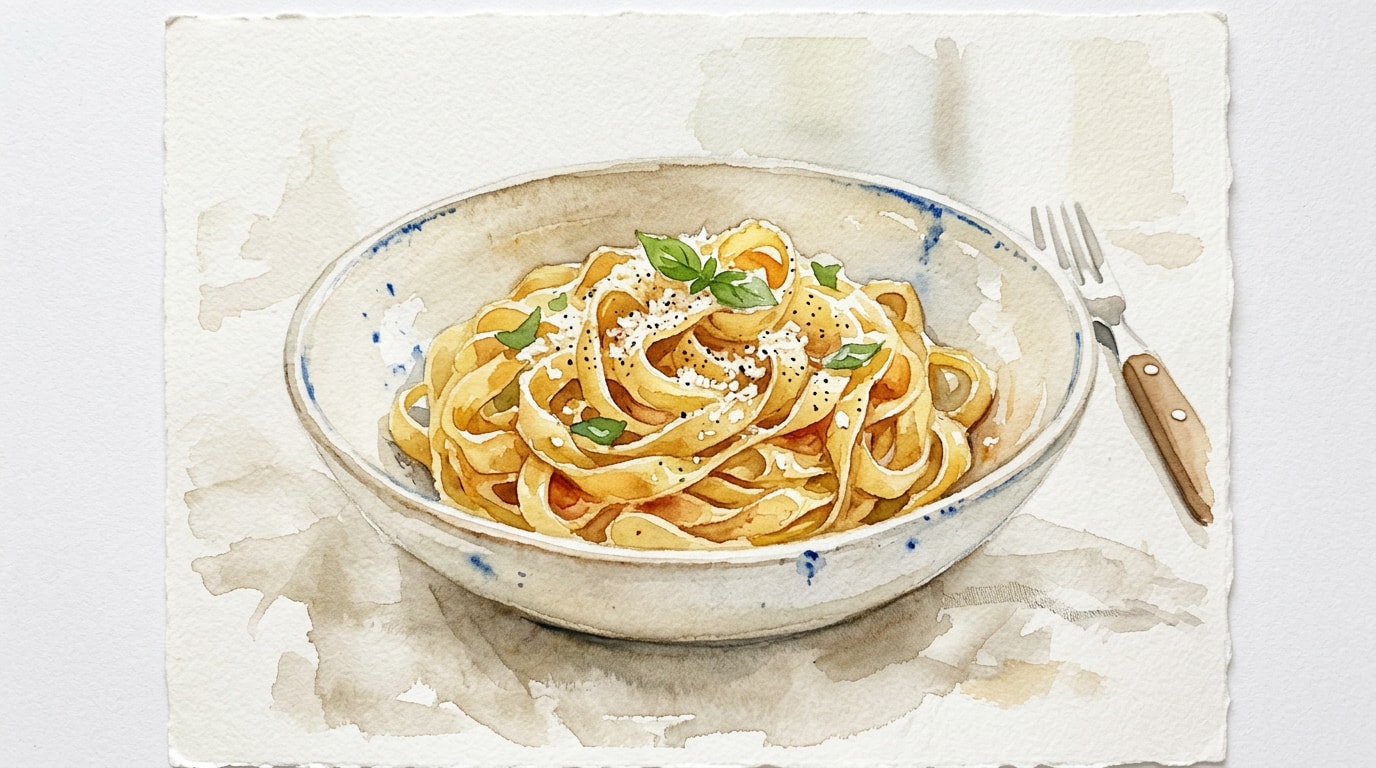
Dust the rolled pasta sheet generously with semolina flour. Cut it into your desired shape using a knife for rustic ribbons like pappardelle, or a pasta machine attachment for linguine or spaghetti.
Bring a large pot of heavily salted water to a rolling boil at 100°C/212°F. Drop the fresh pasta into the water and cook for 2 to 3 minutes, stirring gently to prevent clumping. Remove the cooked pasta using a slotted spoon and transfer immediately to your sauce.
Chef's Notes
- Flour selection defines your pasta. Standard all-purpose flour has medium protein, yielding a pleasant chew. Italian 00 flour is milled exceptionally fine, resulting in a supremely delicate and silky texture.
- Hydration is not an exact science. Environmental humidity and flour age dictate how much liquid you need. Always trust your hands over the exact measurements; the dough should feel like soft modeling clay.
- Salt in the dough is minimal because the cooking water is responsible for seasoning the pasta. Ensure your boiling water tastes like the sea before dropping the noodles in.
- Never skip the resting phase. The 30 minutes allows the flour particles to absorb the egg moisture uniformly, changing the dough from a stiff, unyielding ball into a supple, workable mass.
Storage
Refrigerator: 2 days — Wrap tightly in plastic wrap to prevent the surface from drying out and forming a hard skin.
Freezer: 1 month — Shape into nests, freeze individually on a baking sheet, then transfer to an airtight container.
Reheating: Cook directly from frozen; do not thaw. Add 1 to 2 extra minutes to boiling time.