Equipment
Ingredients
Meat
- 2500 g boneless pork shoulder, excess surface fat trimmed to 6mm
Wet Cure Brine
- 3000 ml water
- 150 g kosher salt
- 150 g dark brown sugar
- 100 g honey
- 14 g prague powder #1, pink curing salt containing 6.25 percent sodium nitrite
- 5 g whole cloves
- 10 g black peppercorns, lightly crushed
- 2 bay leaves
Glaze
- 50 g dark brown sugar
- 30 g honey
- 30 g dijon mustard
Nutrition (per serving)
Method
In a large pot, combine 1000ml of water with kosher salt, dark brown sugar, honey, prague powder #1, cloves, black peppercorns, and bay leaves. Bring to a boil over medium-high heat, stirring until all salts and sugars are completely dissolved. Remove from heat and add the remaining 2000ml of ice-cold water to rapidly chill the liquid. Wait until the brine is completely cool before proceeding.
Place the pork shoulder in a large non-reactive container or heavy duty curing bag. Pour the chilled brine over the meat, ensuring the pork is completely submerged. Weigh the meat down with a heavy plate if necessary. Place in the refrigerator to cure for exactly 7 days, turning the meat once halfway through the week to ensure even cure penetration.
Remove the pork from the brine and discard the liquid. Thoroughly rinse the meat under cold running water to remove excess surface salt and whole spices. Pat completely dry with paper towels. Place the pork on a wire rack set over a baking sheet and return to the refrigerator, uncovered, for 12 to 24 hours to develop a tacky, dry surface called a pellicle.
Preheat your smoker to 107°C/225°F using a mild fruitwood like apple or cherry. Place the cured pork shoulder directly on the smoker grates. Smoke the meat until the internal temperature reaches 60°C/140°F in the thickest part of the muscle, which will take approximately 4 hours.
While the ham is smoking, whisk together the dark brown sugar, honey, and dijon mustard in a small bowl to form a thick glaze. Once the pork hits 60°C/140°F, use a pastry brush to apply the glaze generously over all sides of the ham. Continue smoking until the internal temperature reaches a safe 68°C/155°F and the glaze has transformed into a deeply caramelized, sticky crust.
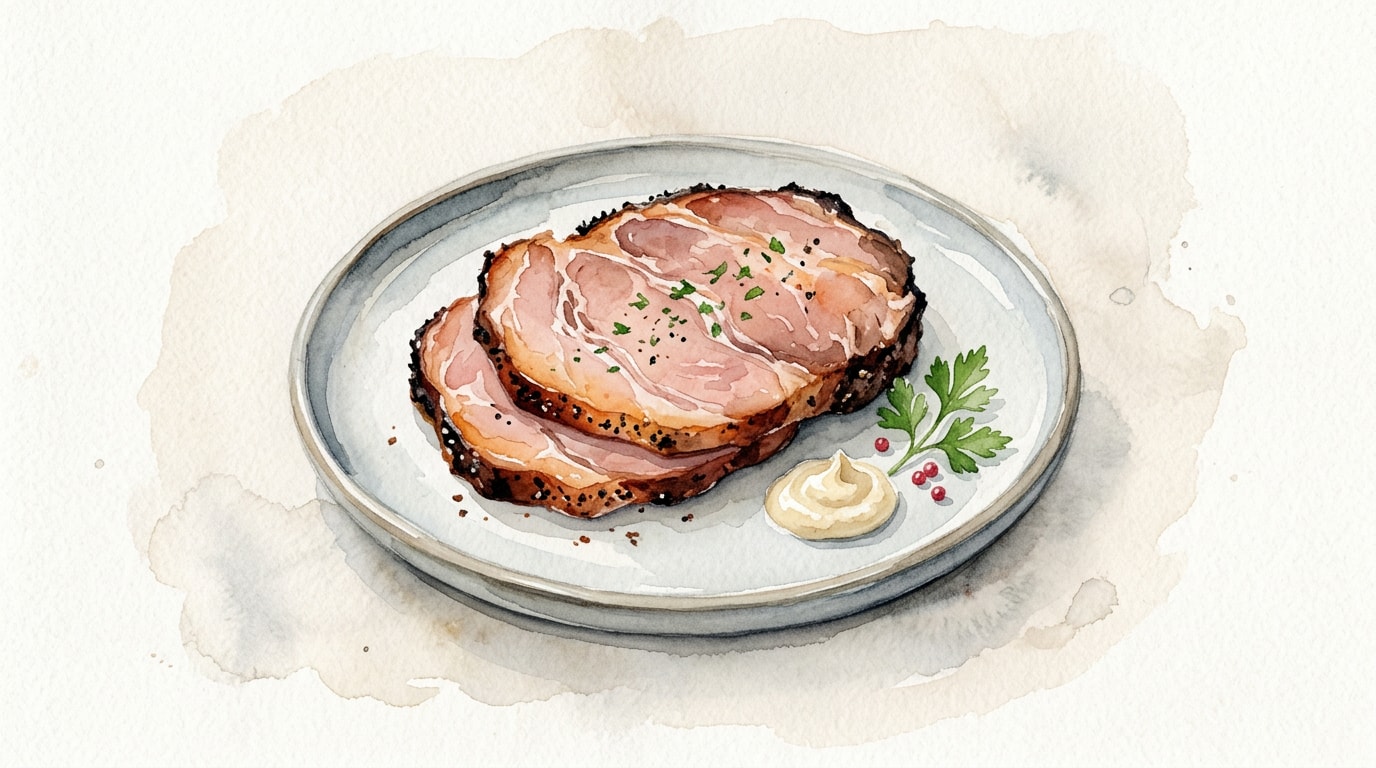
Carefully remove the smoked ham from the smoker and transfer it to a large cutting board. Tent loosely with aluminum foil to retain heat without steaming off the glaze. Allow the ham to rest for at least 30 minutes before slicing against the grain to serve.
Chef's Notes
- Prague Powder #1 is critical for both the characteristic pink hue and the preservation of the meat against botulism during the long, low-temperature smoking process. Never substitute standard table salt for curing salt, and always handle it carefully.
- Forming a pellicle is a non-negotiable step in the smoking process. This tacky layer of concentrated proteins acts as an adhesive, allowing the vaporized wood smoke to cling evenly to the meat rather than washing off with surface moisture.
- Cross-contamination is a serious risk when handling raw pork over a multi-day project. Ensure that any plates, tongs, or containers used during the brining and drying phases are thoroughly sanitized before the cooked ham touches them.
- To achieve the most uniform shape and sliceability, you can tie the boneless shoulder with butcher's twine before submerging it in the cure. This creates a tight, cylindrical roast that cooks evenly and presents beautifully on a carving board.
Storage
Refrigerator: 1 week — Wrap tightly in plastic wrap or foil to prevent drying out.
Freezer: 3 months — Vacuum seal or wrap in multiple layers of freezer paper and foil.
Reheating: Reheat gently covered with foil in a 135C/275F oven with a splash of broth until warmed through to 60C/140F.