Equipment
Ingredients
The Duck
- 1 whole duck, giblets removed
- 2000 ml boiling water
- 15 g kosher salt
Duck-Fat Potatoes
- 1000 g yukon gold potatoes, peeled and quartered
- 60 g duck fat, melted
- 5 g flaky sea salt
Bordelaise Sauce
- 250 ml dry red wine
- 50 g shallots, finely minced
- 2 g fresh thyme, sprigs
- 250 ml veal demi-glace
- 30 g beef bone marrow, poached and diced
Purple Sprouting Broccoli
- 400 g purple sprouting broccoli, woody ends trimmed
- 15 ml olive oil
- 2 g kosher salt
Nutrition (per serving)
Method
Place the raw duck on a wire rack set over the sink. Carefully pour the boiling water over the entire bird to tighten the skin. Thoroughly pat the duck dry inside and out with paper towels. Wash your hands, the sink, and all touched surfaces with hot soapy water immediately to prevent cross-contamination.
Using a sharp needle or the tip of a paring knife, prick the duck skin all over at a shallow angle, ensuring you pierce the fat but not the meat. Rub the kosher salt evenly over the duck. Place the duck breast-side up on a wire rack set inside a roasting pan and refrigerate uncovered for 24 hours to air-dry the skin.
Remove the duck from the refrigerator 1 hour before roasting to remove the chill. Preheat the oven to 150C or 300F.
Roast the duck breast-side up for 1 hour and 30 minutes, pricking the skin occasionally to help render the fat. The internal temperature at the thickest part of the thigh must reach 74C or 165F.
While the duck roasts, place the peeled and quartered potatoes in a large saucepan of cold, heavily salted water. Bring to a boil and cook for 8 to 10 minutes until the edges are just tender.
Drain the potatoes completely, return them to the empty pot, cover with the lid, and shake vigorously to rough up the edges. Remove the lid and allow them to steam dry for 5 minutes.
Remove the duck from the oven and carefully transfer it to a resting plate. Pour off the rendered duck fat from the roasting pan into a heatproof bowl. Increase the oven temperature to 220C or 425F.
Toss the fluffed potatoes gently in 60g of the reserved melted duck fat and spread them in an even layer on a baking sheet. Return the duck to the oven on its wire rack, placing the baking sheet of potatoes on a lower rack. Roast both for 20 to 25 minutes.
Meanwhile, prepare the sauce. In a small saucepan, combine the red wine, minced shallots, and thyme sprigs. Simmer over medium heat until the liquid is reduced by three-quarters and has a syrupy consistency.
Stir the veal demi-glace into the wine reduction. Simmer gently for 5 minutes until it thickens enough to coat the back of a spoon. Strain through a fine mesh sieve into a clean pan, discarding the solids. Whisk in the poached bone marrow or cold butter off the heat until fully emulsified.
Bring a fresh pot of salted water to a rolling boil. Blanch the purple sprouting broccoli for 3 to 4 minutes. Drain thoroughly, return to the warm pot, and toss with the olive oil and kosher salt.
Remove the duck and potatoes from the oven. Let the duck rest, loosely tented with a piece of foil, for 15 minutes before carving to allow the juices to redistribute.
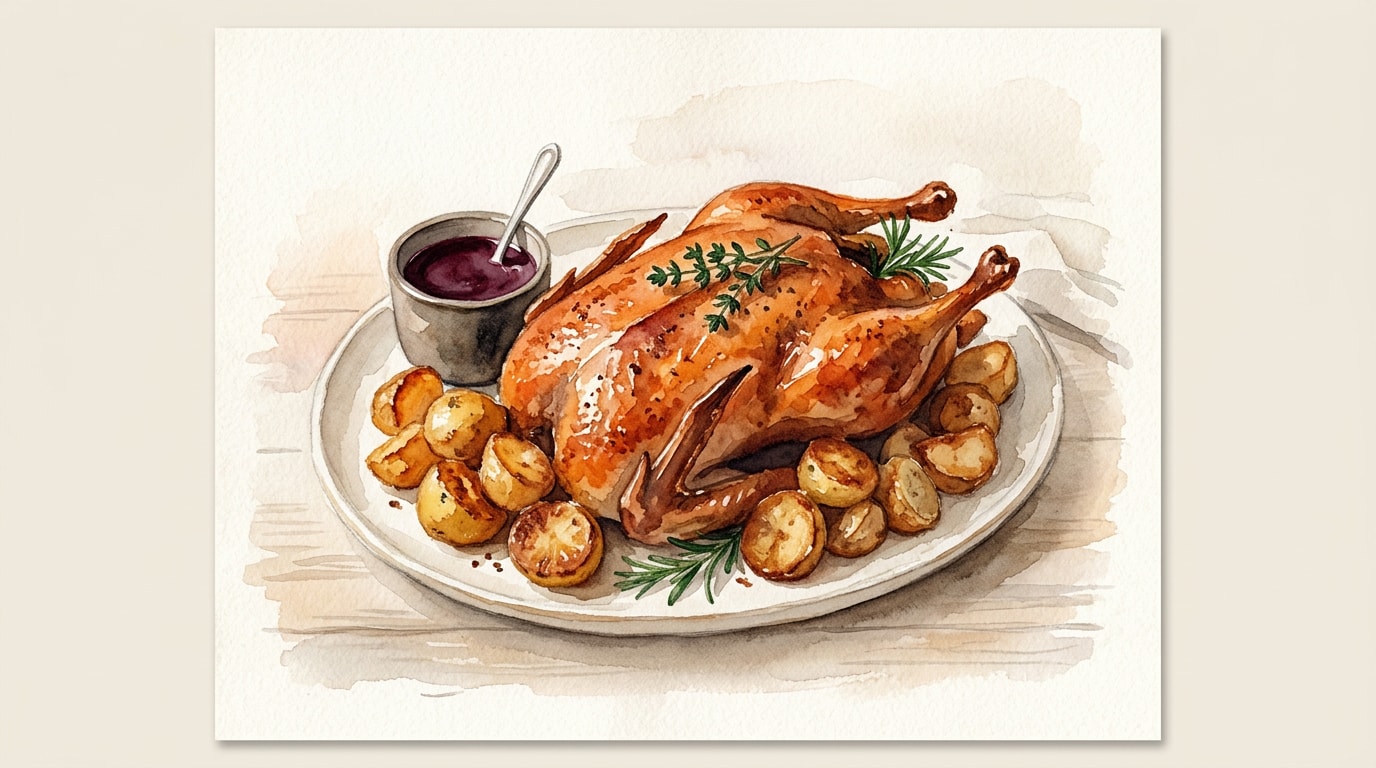
Carve the rested duck. Serve immediately on warmed plates alongside the crispy duck-fat potatoes and vibrant sprouting broccoli, with the rich bordelaise sauce drizzled generously over the meat.
Chef's Notes
- Pouring boiling water over the raw duck causes the skin to shrink and pull tightly against the meat, which helps maximize crispiness during the roast by starting the rendering process early.
- Do not discard any leftover rendered duck fat. Strain it through a coffee filter and keep it in the refrigerator; it is culinary gold for roasting vegetables or searing steaks.
- Real bone marrow elevates a bordelaise by providing a distinct, earthy richness that butter cannot replicate. Ask your butcher to split marrow bones lengthwise to make harvesting the marrow easier.
- Purple sprouting broccoli cooks much faster than traditional calabrese broccoli. Its natural bitterness is the perfect foil to the rich duck and heavy bordelaise sauce.
Storage
Refrigerator: 3 days — Store components separately. Duck skin will lose its crispness in the refrigerator.
Freezer: 1 month — Duck meat and sauce freeze well. Do not freeze the roasted potatoes or cooked broccoli.
Reheating: Reheat duck and potatoes in a 200C oven for 10-15 minutes until hot and crisped. Gently warm the sauce on the stovetop.