Equipment
Ingredients
Meat
- 600 g veal or pork loin cutlets, boneless, trimmed
Breading Station
- 100 g all-purpose flour
- 2 eggs, beaten
- 150 g fine dry breadcrumbs, unseasoned
- 10 g kosher salt
- 2 g black pepper, freshly ground
Frying and Serving
- 300 ml neutral oil
- 1 lemon, cut into wedges
- 5 g fresh parsley, finely chopped
Nutrition (per serving)
Method
Place the cutlets one at a time between two sheets of heavy plastic wrap. Using the smooth side of a meat mallet, gently pound them from the center outwards to a uniform thickness of 4 to 6 millimeters (about 1/4 inch).
Generously season both sides of the pounded cutlets with the kosher salt and black pepper.
Set up a standard breading station using three shallow bowls. Place the flour in the first bowl, the thoroughly beaten eggs in the second, and the breadcrumbs in the third. Dredge each cutlet in the flour, shaking off any excess. Dip it into the egg, ensuring the meat is completely coated, and let the excess drip off. Finally, place the cutlet in the breadcrumbs, tossing to coat. Do not press the breadcrumbs into the meat; let them adhere naturally for a lighter crust.
In a large skillet, heat the neutral oil over medium-high heat until it reaches 170°C/340°F. Ensure the oil is at least 1 centimeter deep so the schnitzel can float rather than sit flat on the bottom of the pan.
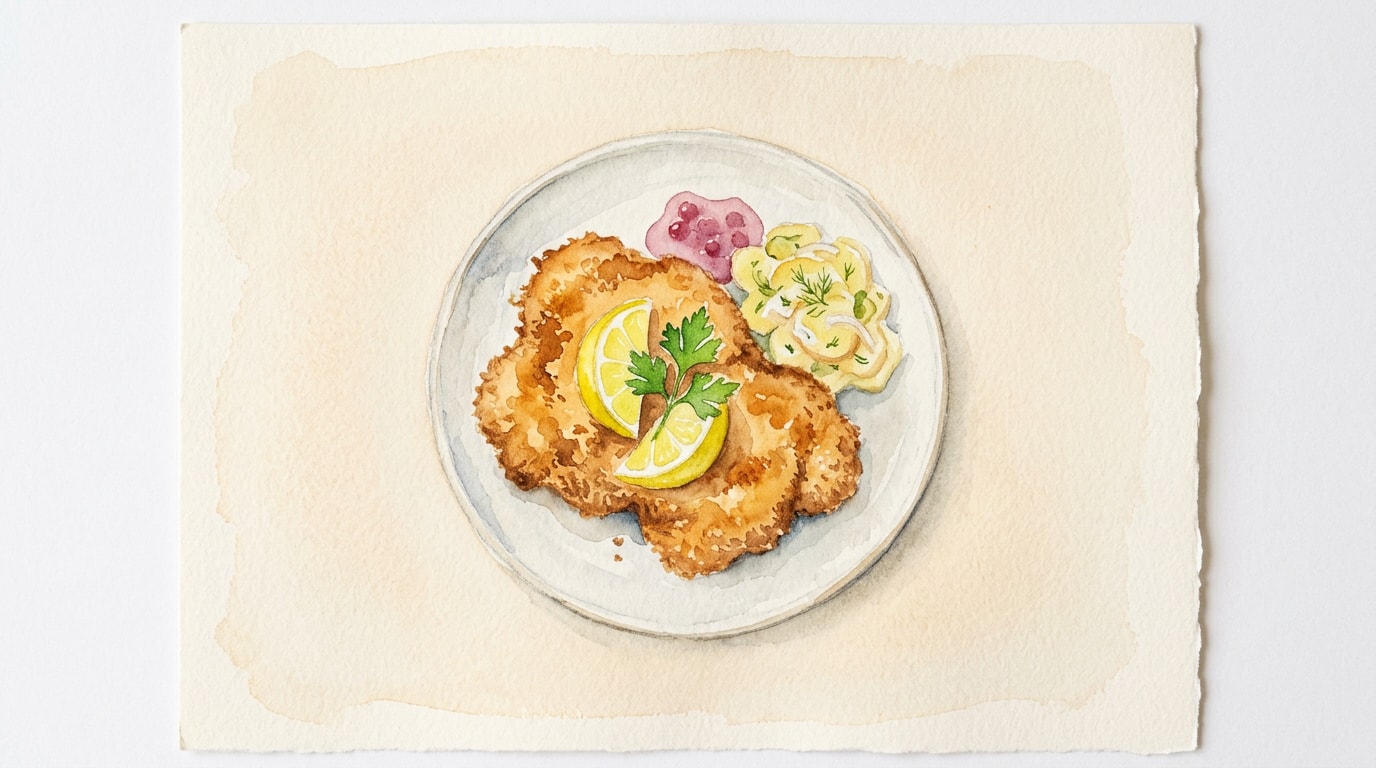
Carefully slide the breaded cutlets into the hot oil, working in batches if necessary to avoid crowding. Fry for 2 to 3 minutes per side. While frying, gently and continuously swirl the pan so the hot oil washes over the top of the schnitzel. This technique creates the signature wavy, puffed crust. Cook until golden brown and crispy.
Remove the schnitzels from the oil and immediately transfer them to a wire rack. Let them rest for 2 minutes. Do not drain on paper towels as the trapped steam will make the bottom soggy. Garnish with chopped parsley and serve immediately with fresh lemon wedges.
Chef's Notes
- Never press the breadcrumbs into the meat. The air trapped loosely between the egg wash and the breadcrumbs is essential for the crust to soufflé and separate from the meat during frying.
- Swirling the pan (soufflieren) is the most critical technique in schnitzel making. The continuous washing of hot oil over the top cooks the crust evenly and generates the steam required for the classic wavy appearance.
- Clarified butter (Butterschmalz) is the traditional Austrian frying medium and imparts an incredible nutty flavor, but neutral oils work wonderfully for a cleaner, dairy-free result.
- Pounding the meat serves two purposes: it tenderizes the muscle fibers and ensures a completely uniform thickness so the meat cooks in the exact same time it takes for the crust to brown.
Storage
Refrigerator: 2 days — Loses crispness rapidly. Store in an airtight container lined with paper towels.
Freezer: 1 month — Best frozen raw immediately after breading, separated by parchment paper.
Reheating: Reheat in a 200C oven on a wire rack for 8-10 minutes. Do not microwave.