Equipment
Ingredients
Main
- 600 g grade a duck foie gras, whole lobe, brought to room temperature for 45 minutes
Seasoning and Cure
- 8 g kosher salt
- 2 g white pepper, finely ground
- 2 g caster sugar
- 15 ml ruby port
Nutrition (per serving)
Method
Carefully separate the large and small lobes of the foie gras. Using the back of a spoon and tweezers, delicately butterfly the lobes and trace out the primary and secondary vein networks. Pull them out gently to avoid completely destroying the liver structure.
Sprinkle the kosher salt, white pepper, and caster sugar evenly over all exposed internal and external surfaces of the liver, then drizzle the ruby port evenly over the top.
Transfer the seasoned liver to an airtight container, cover firmly, and refrigerate for 24 hours to cure, allowing the salt to penetrate and the flavors to mature.
Preheat the oven to 100 degrees Celsius (210 degrees Fahrenheit). Bring a kettle of water to a boil to prepare the water bath.
Pack the cured foie gras tightly into a ceramic terrine mold, pressing down firmly to eliminate any hidden air pockets. Smooth the top surface as much as possible.
Place the terrine mold inside a deep roasting pan. Pour the boiling water into the pan until it reaches halfway up the outside of the mold. Bake until the internal temperature of the terrine reaches exactly 45 degrees Celsius (113 degrees Fahrenheit).
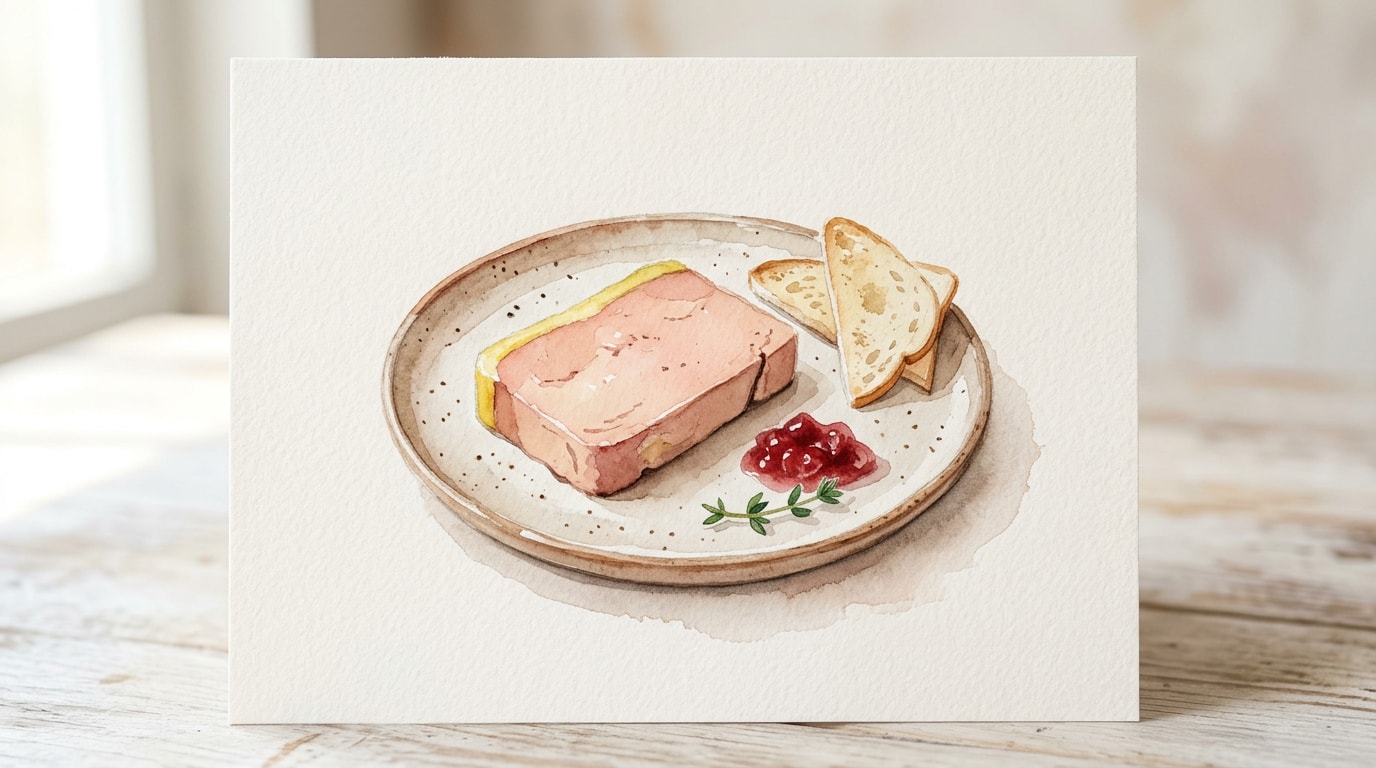
Remove the terrine from the water bath. Carefully pour off the excess liquid yellow fat into a clean jar and reserve it. Place a piece of cardboard, cut to fit the inside of the terrine and wrapped in foil, directly on top of the liver. Weigh the cardboard down with a heavy can to compress the meat.
Transfer the pressed terrine to the refrigerator. Allow it to fully chill and set under the weight for at least 48 hours before slicing and serving.
Chef's Notes
- Temperature control is the absolute most critical element of this preparation. Pulling the terrine at exactly 45 degrees Celsius ensures the delicate fat matrix holds its structure without melting completely.
- Never discard the clear yellow rendered fat. It is phenomenal for searing steaks, roasting potatoes, or pouring back over the finished chilled terrine to create an airtight seal.
- A Grade A lobe is mandatory for terrines. Grade B or C lobes contain too much water and too many large veins, resulting in massive shrinkage and poor texture.
- Do not skip the 48-hour resting period. Foie gras needs time under refrigeration to reabsorb some of its seasoned fat and mature its flavor profile.
Storage
Refrigerator: 1 week — Must remain tightly covered or sealed under its own rendered fat cap.
Freezer: 3 months — Vacuum seal to prevent oxidation; texture may slightly degrade upon thawing.