Equipment
Ingredients
Royal Icing Daisies
- 240 g icing sugar, sifted
- 30 g pasteurized egg whites, room temperature
- 2 ml lemon juice, freshly squeezed
- 1 g yellow food coloring, gel preferred
Classic Yellow Cake
- 340 g cake flour, sifted
- 12 g baking powder
- 4 g salt, fine
- 225 g unsalted butter, room temperature
- 350 g granulated sugar
- 4 eggs, room temperature
- 10 ml vanilla extract
- 240 ml whole milk, room temperature
Vanilla Buttercream
- 340 g unsalted butter, softened to room temperature
- 600 g icing sugar, sifted
- 15 ml vanilla extract
- 45 ml whole milk, room temperature
- 2 g salt
Nutrition (per serving)
Method
For the royal icing, combine the sifted icing sugar, pasteurized egg whites, and lemon juice in a stand mixer bowl. Beat on medium-high speed until stiff peaks form, about 5 to 7 minutes.
Separate about 30 grams of the royal icing into a small bowl and mix in the yellow food coloring for the daisy centers. Leave the remaining icing white. Transfer the white icing to a piping bag fitted with a petal piping tip, and the yellow icing to a bag with a round piping tip.
Using a dab of icing, secure a parchment paper square to your flower nail. With the wide end of the petal tip resting on the nail, pipe individual petals while slowly spinning the nail to form a complete daisy. Finish with a dot of yellow icing in the center. Carefully slide the parchment square off the nail and set aside. Repeat to make at least 20 daisies. Allow to dry completely at room temperature for 24 hours.
Preheat the oven to 175°C/350°F. Grease two 8-inch round cake pans and line the bottoms with parchment paper.
In a medium bowl, whisk together the cake flour, baking powder, and salt. Set aside.
In a stand mixer fitted with the paddle attachment, cream the room temperature unsalted butter and granulated sugar on medium speed until exceptionally light and fluffy, about 4 to 5 minutes.
Reduce the mixer speed to low. Beat in the eggs one at a time, ensuring each is fully incorporated before adding the next. Scrape down the sides of the bowl, then mix in the vanilla extract.
With the mixer on low speed, add the dry flour mixture in three additions, alternating with the whole milk in two additions, beginning and ending with the dry ingredients. Mix just until combined. Do not overmix.
Divide the batter evenly between the prepared cake pans. Bake at 175°C/350°F for 30 to 35 minutes, or until a wooden skewer inserted into the center comes out clean.
Allow the cakes to cool in their pans for 10 minutes, then invert them onto a wire cooling rack to cool completely.
For the buttercream, beat the softened unsalted butter in a stand mixer on medium-high speed until pale and creamy, about 3 minutes. Gradually add the sifted icing sugar on low speed. Once incorporated, add the vanilla extract, whole milk, and salt. Increase speed to medium-high and whip for another 3 minutes until light and airy.
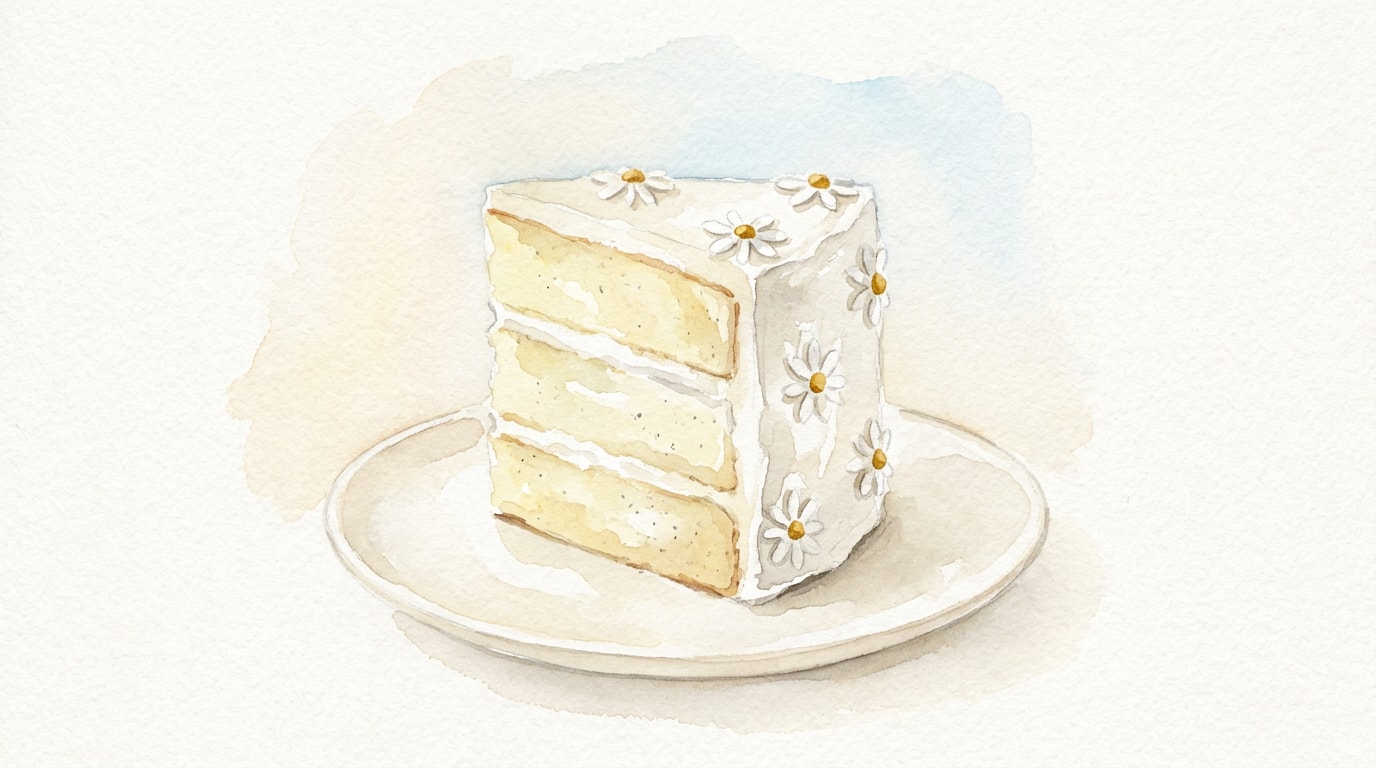
Using a serrated knife, level the cooled cake layers if they have domed. Place the first layer on a serving platter, spread a thick, even layer of buttercream using an offset spatula, and top with the second cake layer. Frost the top and sides of the entire cake smoothly.
Carefully peel the dried royal icing daisies away from the parchment squares. Gently press them into the fresh buttercream on the top and sides of the cake in a cascading pattern to garnish. Serve immediately or store at room temperature.
Chef's Notes
- Always pipe 20 percent more royal icing flowers than you calculate needing, as some will inevitably snap or crack during the delicate transfer process.
- Room temperature ingredients are absolutely crucial for a tender crumb. Cold eggs hitting creamed butter will seize the fat, breaking the emulsion and resulting in a dense cake.
- To achieve a silky smooth American buttercream without jagged air pockets, whip it to maximum fluffiness, then take a wooden spoon and stir it vigorously by hand for two minutes. This knocks out the large air bubbles.
- Store the dried royal icing flowers in an airtight container at room temperature away from direct sunlight, as UV light can rapidly fade your yellow food coloring.
Storage
Refrigerator: 5 days — Store in a cake keeper or airtight container to prevent drying. Bring to room temperature for 2 hours before serving.
Freezer: 3 months — Unfrosted cake layers can be wrapped tightly in plastic wrap and foil and frozen. Thaw at room temperature.