Equipment
Ingredients
Omelette Base
- 3 large eggs, room temperature
- 15 g unsalted butter, cubed
- 1 g salt
- ½ g white pepper
Filling
- 30 g gruyère cheese, finely grated
- 2 g fresh chives, finely snipped
- 2 g fresh parsley, finely chopped
- 1 g fresh tarragon, finely chopped
- 1 g fresh chervil, finely chopped
Nutrition (per serving)
Method
Combine the chives, parsley, tarragon, and chervil in a small dish. Grate the Gruyère cheese.
Crack eggs into a mixing bowl. Season with salt and white pepper. Whisk vigorously with a fork until the whites and yolks are completely homogenized and no streaks remain, but try to minimize introducing large air bubbles.
Place the non-stick pan over medium-low heat. Add the butter and let it melt. When the butter foams and sizzles (but before it browns), the pan is ready (approx 140°C/285°F surface temp).
Pour the eggs into the pan. Immediately begin shaking the pan back and forth vigorously with one hand while stirring the eggs rapidly with the fork (tines flat against the pan) in a circular motion with the other hand. Do this for 30-45 seconds to create small curds.
When the eggs look like wet scrambled eggs but the bottom has just started to set into a skin, stop stirring. Use the spatula to smooth the egg layer evenly. The top should still be runny (baveuse).
Sprinkle the mixed herbs and grated Gruyère in a line across the center of the eggs (perpendicular to the handle).
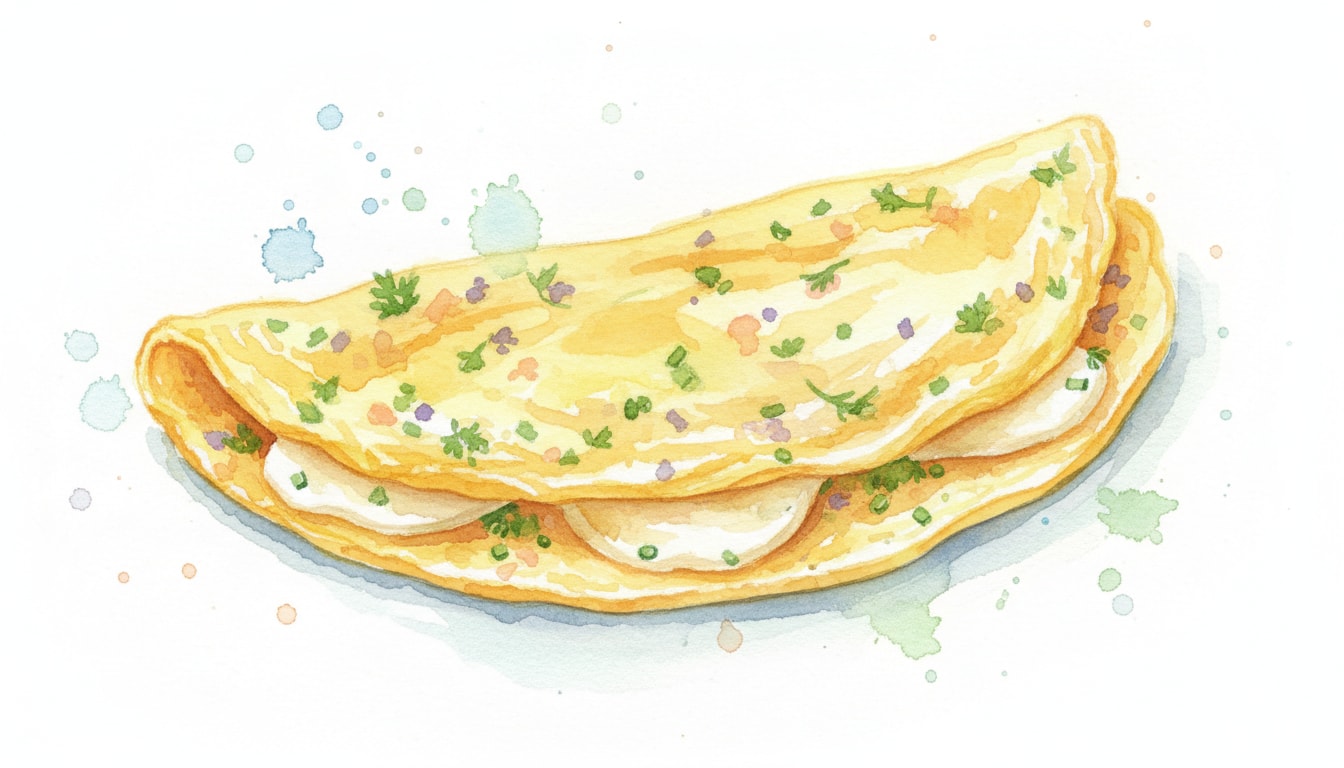
Tilt the pan handle up at a 45-degree angle. Using the spatula (or gravity and a tap on the handle), roll the top edge of the omelette down over the filling to the center. Roll the bottom edge up to meet it, or roll the whole omelette toward the bottom edge of the pan.
Change your grip on the pan handle to underhand. Hover the pan over a warm plate, tilt the pan until vertical, and roll the omelette out onto the plate so the seam sits underneath.
Optional: Rub a small piece of cold butter over the hot surface of the omelette for shine. Serve immediately.
Chef's Notes
- The interior should be 'baveuse'—runny and creamy. If the eggs are fully solid, it is overcooked.
- Using a fork directly in a non-stick pan requires a light touch to avoid scratching; use a silicone spatula or chopsticks if you are worried about your equipment.
- If you lack confidence in rolling, simply fold the omelette in half. It is less traditional but equally delicious.
- Room temperature eggs cook more evenly and faster than fridge-cold eggs.
Storage
Refrigerator: 1 day — Texture degrades significantly; best eaten immediately.
Reheating: Not recommended; rubbery texture results.